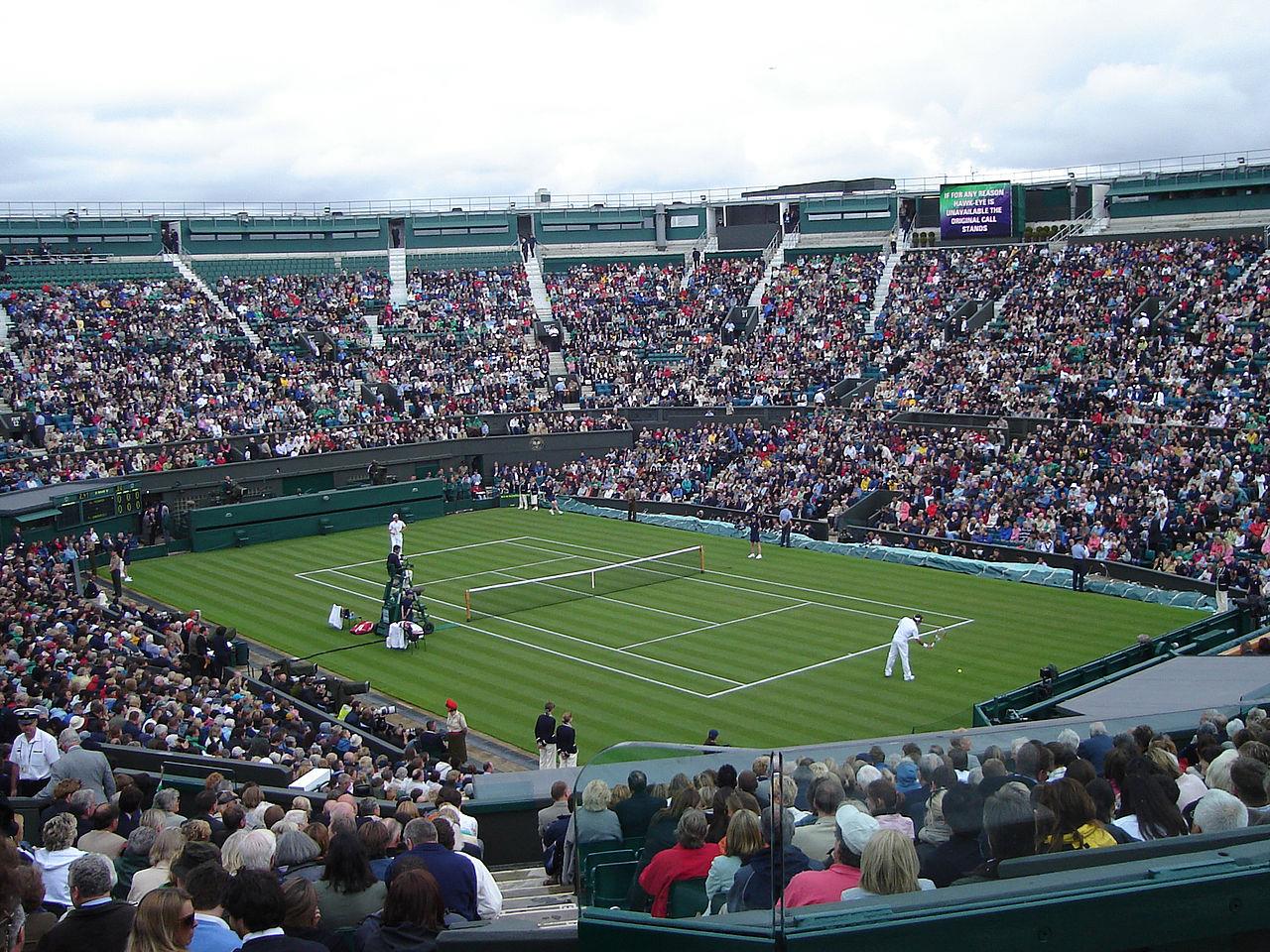
Tennis is a racket sport that can be played individually against a single opponent (singles) or between two teams of two players each (doubles). Each player uses a tennis racket that is strung with cord to strike a hollow rubber ball covered with felt over or around a net and into the opponent's court. The object of the game is to play the ball in such a way that the opponent is not able to play a valid return. The player who is unable to return the ball will not gain a point, while the opposite player will.
Tennis is an Olympic sport and is played at all levels of society and at all ages. The sport can be played by anyone who can hold a racket, including wheelchair users. The modern game of tennis originated in Birmingham, England, in the late 19th century as "lawn tennis".[1] It had close connections both to various field ("lawn") games such as croquet and bowls as well as to the older racket sport of real tennis. During most of the 19th century, in fact, the term "tennis" referred to real tennis, not lawn tennis: for example, in Disraeli's novel Sybil (1845), Lord Eugene De Vere announces that he will "go down to Hampton Court and play tennis."
The rules of tennis have changed little since the 1890s. Two exceptions are that from 1908 to 1961 the server had to keep one foot on the ground at all times, and the adoption of the tiebreak in the 1970s. A recent addition to professional tennis has been the adoption of electronic review technology coupled with a point challenge system, which allows a player to contest the line call of a point, a system known as Hawk-Eye.
Tennis is played by millions of recreational players and is also a popular worldwide spectator sport. The four Grand Slam tournaments (also referred to as the "Majors") are especially popular: the Australian Open played on hard courts, the French Open played on red clay courts, Wimbledon played on grass courts, and the US Open played also on hard courts.
History
Predecessors

Historians believe that the game's ancient origin lay in 12th century northern France, where a ball was struck with the palm of the hand.[3] Louis X of France was a keen player of jeu de paume ("game of the palm"), which evolved into real tennis, and became notable as the first person to construct indoor tennis courts in the modern style. Louis was unhappy with playing tennis outdoors and accordingly had indoor, enclosed courts made in Paris "around the end of the 13th century".[4] In due course this design spread across royal palaces all over Europe.[4] In June 1316 at Vincennes, Val-de-Marne and following a particularly exhausting game, Louis drank a large quantity of cooled wine and subsequently died of either pneumonia or pleurisy, although there was also suspicion of poisoning.[5] Because of the contemporary accounts of his death, Louis X is history's first tennis player known by name.[5] Another of the early enthusiasts of the game was King Charles V of France, who had a court set up at the Louvre Palace.[6]
It wasn't until the 16th century that rackets came into use, and the game began to be called "tennis", from the French term tenez, which can be translated as "hold!", "receive!" or "take!", an interjection used as a call from the server to his opponent.[7] It was popular in England and France, although the game was only played indoors where the ball could be hit off the wall. Henry VIII of England was a big fan of this game, which is now known as real tennis.[8] During the 18th century and early 19th century, as real tennis declined, new racket sports emerged in England.[9]
Further, the patenting of the first lawn mower in 1830, in Britain, is strongly believed to have been the catalyst, worldwide, for the preparation of modern-style grass courts, sporting ovals, playing fields, pitches, greens, etc. This in turn led to the codification of modern rules for many sports, including lawn tennis, most football codes, lawn bowls and others.[10]
Origins of the modern game

Between 1859 and 1865 Harry Gem and his friend Augurio Perera developed a game that combined elements of racquets and the Basque ball game pelota, which they played on Perera's croquet lawn in Birmingham, England, United Kingdom.[11][12] In 1872, along with two local doctors, they founded the world's first tennis club in Leamington Spa.[13]
In December 1873, British army officer Major Walter Clopton Wingfield designed and patented a similar game ;– which he called sphairistikè (Greek: σφαιριστική, meaning "ball-playing"), and was soon known simply as "sticky" – for the amusement of guests at a garden party on his friend's estate of Nantclwyd Hall, in Llanelidan, Wales.[14] According to R. D. C. Evans, turfgrass agronomist, "Sports historians all agree that [Wingfield] deserves much of the credit for the development of modern tennis."[9][15] According to Honor Godfrey, museum curator at Wimbledon, Wingfield "popularized this game enormously. He produced a boxed set which included a net, poles, rackets, balls for playing the game – and most importantly you had his rules. He was absolutely terrific at marketing and he sent his game all over the world. He had very good connections with the clergy, the law profession, and the aristocracy and he sent thousands of sets out in the first year or so, in 1874."[16] The world's oldest tennis tournament, the Wimbledon Championships, were first played in London in 1877.[16][17] The first Championships culminated a significant debate on how to standardize the rules.
In the U.S. in 1874 Mary Ewing Outerbridge, a young socialite, returned from Bermuda with a sphairistikè set. She became fascinated by the game of tennis after watching British army officers play.[18] She laid out a tennis court at the Staten Island Cricket Club at Camp Washington, Tompkinsville, Staten Island, New York. The first American National championship was played there in September 1880. An Englishman named O.E. Woodhouse won the singles title, and a silver cup worth $100, by defeating Canadian I. F. Hellmuth.[19] There was also a doubles match which was won by a local pair. There were different rules at each club. The ball in Boston was larger than the one normally used in New York. On 21 May 1881, the United States National Lawn Tennis Association (now the United States Tennis Association) was formed to standardize the rules and organize competitions.[20] The U.S. National Men's Singles Championship, now the US Open, was first held in 1881 at the Newport Casino, Newport, Rhode Island.[21] The U.S. National Women's Singles Championships were first held in 1887 in Philadelphia.

Tennis also became popular in France, where the French Championships dates to 1891 although until 1925 it was open only to tennis players who were members of French clubs.[23]Thus, Wimbledon, the US Open, the French Open, and the Australian Open (dating to 1905) became and have remained the most prestigious events in tennis.[17][24] Together these four events are called the Majors or Slams (a term borrowed from bridge rather than baseball).[25]

The comprehensive rules promulgated in 1924 by the International Lawn Tennis Federation, now known as the International Tennis Federation (ITF), have remained largely stable in the ensuing eighty years, the one major change being the addition of the tiebreak system designed by Jimmy Van Alen.[26] That same year, tennis withdrew from the Olympics after the 1924 Games but returned 60 years later as a 21-and-under demonstration event in 1984. This reinstatement was credited by the efforts by the then ITF President Philippe Chatrier, ITF General Secretary David Gray and ITF Vice President Pablo Llorens, and support from IOC President Juan Antonio Samaranch. The success of the event was overwhelming and the IOC decided to reintroduce tennis as a full medal sport at Seoul in 1988.[27][28]

The Davis Cup, an annual competition between men's national teams, dates to 1900.[29] The analogous competition for women's national teams, the Fed Cup, was founded as the Federation Cup in 1963 to celebrate the 50th anniversary of the founding of the ITF.[30]
In 1926, promoter C. C. Pyle established the first professional tennis tour with a group of American and French tennis players playing exhibition matches to paying audiences.[24][31] The most notable of these early professionals were the American Vinnie Richards and the Frenchwoman Suzanne Lenglen.[24][32] Once a player turned pro he or she could not compete in the major (amateur) tournaments.[24]
In 1968, commercial pressures and rumors of some amateurs taking money under the table led to the abandonment of this distinction, inaugurating the Open Era, in which all players could compete in all tournaments, and top players were able to make their living from tennis. With the beginning of the Open Era, the establishment of an international professional tennis circuit, and revenues from the sale of television rights, tennis's popularity has spread worldwide, and the sport has shed its middle-class English-speaking image[33] (although it is acknowledged that this stereotype still exists).[33][34]
In 1954, Van Alen founded the International Tennis Hall of Fame, a non-profit museum in Newport, Rhode Island.[35] The building contains a large collection of tennis memorabilia as well as a hall of fame honouring prominent members and tennis players from all over the world. Each year, a grass court tournament and an induction ceremony honoring new Hall of Fame members are hosted on its grounds.
Equipment
Part of the appeal of tennis stems from the simplicity of equipment required for play. Beginners need only a racket and balls.
Rackets

The components of a tennis racket include a handle, known as the grip, connected to a neck which joins a roughly elliptical frame that holds a matrix of tightly pulled strings. For the first 100 years of the modern game, rackets were made of wood and of standard size, and strings were of animal gut. Laminated wood construction yielded more strength in rackets used through most of the 20th century until first metal and then composites of carbon graphite, ceramics, and lighter metals such as titanium were introduced. These stronger materials enabled the production of oversized rackets that yielded yet more power. Meanwhile, technology led to the use of synthetic strings that match the feel of gut yet with added durability.
Under modern rules of tennis, the rackets must adhere to the following guidelines;[36]
- The hitting area, composed of the strings, must be flat and generally uniform.
- The frame of the hitting area may not be more than 29 inches (74 cm) in length and 12.5 inches (32 cm) in width.
- The entire racket must be of a fixed shape, size, weight, and weight distribution. There may not be any energy source built into the rackets.
- The rackets must not provide any kind of communication, instruction or advice to the player during the match.
The rules regarding rackets have changed over time, as material and engineering advances have been made. For example, the maximum length of the frame had been 32 inches (81 cm) until 1997, when it was shortened to 29 inches (74 cm).[37]

Many companies manufacture and distribute tennis rackets. Wilson, Head and Babolat are some of the more commonly used brands; however, many more companies exist. The same companies sponsor players to use these rackets in the hopes that the company name will become more well known by the public.
Balls
Tennis balls were originally made of cloth strips stitched together with thread and stuffed with feathers.[38] Modern tennis balls are made of hollow vulcanized rubber with a felt coating. Traditionally white, the predominant colour was gradually changed to optic yellow in the latter part of the 20th century to allow for improved visibility. Tennis balls must conform to certain criteria for size, weight, deformation, and bounce to be approved for regulation play. The International Tennis Federation (ITF) defines the official diameter as 65.41–68.58 mm (2.575–2.700 in). Balls must weigh between 56.0 and 59.4 g (1.98 and 2.10 oz).[39] Tennis balls were traditionally manufactured in the United States and Europe. Although the process of producing the balls has remained virtually unchanged for the past 100 years, the majority of manufacturing now takes place in the Far East. The relocation is due to cheaper labour costs and materials in the region.[40]
Miscellaneous
Advanced players improve their performance through a number of accoutrements. Vibration dampeners may be interlaced in the proximal part of the string array for improved feel. Racket handles may be customized with absorbent or rubber-like materials to improve the players' grip. Players often use sweat bands on their wrists to keep their hands dry and head bands or bandanas to keep the sweat out of their eyes as well. Finally, although the game can be played in a variety of shoes, specialized tennis shoes have wide, flat soles for stability and a built-up front structure to avoid excess wear.